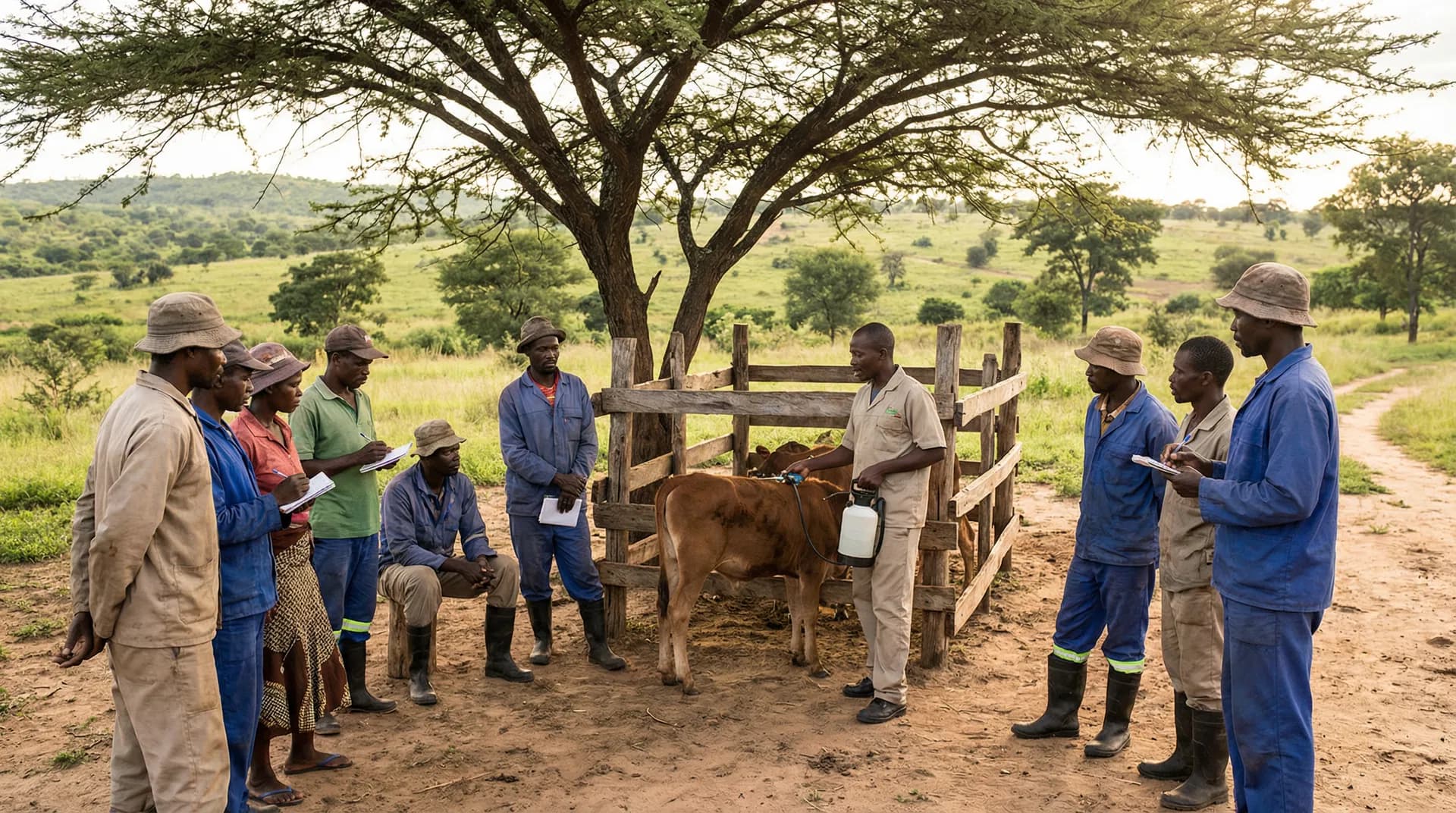
Zambian farmer with cattle herd
Knowledge Hub

Farming & Livestock Resource Centre

Curated research, practical guides, and industry insights for Zambian farmers, currently focused on tick control and livestock health, with more topics added as our catalog grows.

5.1M
Cattle in Zambia
$250M+
Annual TBD losses (Africa)
70%
Farmers affected by ticks
4+
Major TBDs in Zambia
Farmer Manuals

Practical Knowledge Hub Manuals

Field-ready manuals for farmers, farm workers, cooperatives, sales agents, and extension teams. Each manual is designed to support practical training and everyday farm decisions.

Manual 1

Livestock Basics

7 chapters

Simple field guidance for spotting sick animals, checking condition, using medicines safely, and knowing when to call a para-vet.

Best for

New and growing livestock farmers

1

How to check if your animal is sick

Observe behaviour, appetite, movement, breathing, coat condition, manure, and isolation from the herd.

2

Is my animal too thin?

Use body condition scoring to judge whether cattle, goats, sheep, pigs, or poultry are losing condition.

3

How to take an animal's temperature

Practical steps for using a thermometer and understanding when a fever needs urgent attention.

4

Common sicknesses in Zambia

Quick farmer-level signs for common livestock problems, with emphasis on early reporting.

5

First aid for wounds and injuries

Clean wounds, control bleeding, separate injured animals, and avoid unsafe home treatments.

6

When to call the para-vet

Clear triggers for professional help versus simple observation or routine care.

7

Using medicines safely

Read labels, measure doses correctly, observe withdrawal periods, and keep medicine records.

Manual 2

Pasture, Feed & Water

7 chapters

A practical guide to feeding, grazing, breeding, housing, water, records, and herd growth for smallholder and emerging commercial farms.

Best for

Farmers building stronger daily routines

1

Feeding your animals

Match feed to age, species, production stage, season, and available farm resources.

2

Pasture grasses

Use Bracharia, Panicum, Rhodes, and other grasses to improve grazing and reduce bought feed.

3

Breeding basics

Breed at the right age and condition, avoid weak animals, and plan for healthy offspring.

4

Housing

Keep kraals, chicken houses, goat houses, and pig sties dry, ventilated, clean, and secure.

5

Clean water

Provide enough clean water every day and protect troughs, tanks, wells, and streams from contamination.

6

Record keeping

Track births, deaths, treatments, vaccinations, purchases, sales, and breeding dates.

7

Growing your herd or flock

Build numbers gradually through health, breeding, feed planning, and realistic cash flow.

Manual 3

Seasonal Health Calendar

6 chapters

Season-by-season reminders for vaccination, dipping, deworming, rainy season risk, dry season preparation, feed, and water planning.

Best for

Farmers planning the full farming year

1

Zambia's farming year

Understand the rainy season, dry cool season, and dry hot season as different risk periods.

2

Vaccination calendar

Plan vaccinations before high-risk periods and protect the cold chain for every dose.

3

Dipping and deworming calendar

Adjust tick and worm control around rainfall, grazing pressure, and visible parasite load.

4

Rainy season

Watch for ticks, foot problems, pneumonia, wet bedding, and fast-spreading disease.

5

Dry cool season

Use the lower-pressure period for repairs, breeding preparation, pasture planning, and herd checks.

6

Dry hot season

Plan feed reserves, water access, shade, and early action before animals lose condition.

Manual 4

Farm & Environment

6 chapters

Environmental farm management guidance covering bush burning, tree replanting, hazardous waste, water hygiene, compost, and climate-smart basics.

Best for

Farmers protecting land, water, trees, and long-term productivity

1

Bush burning

Know when burning harms soil, pasture, trees, animals, and homes, and use safer alternatives.

2

Cutting trees for malasha

For every tree cut, plant more; prioritise indigenous trees, fodder trees, shade, and woodlots.

3

Farm rubbish

Triple-rinse chemical containers, puncture them, bury hazardous waste safely, and never reuse chemical drums for food or water.

4

Water hygiene

Fix leaks, cover tanks, scrub troughs, protect wells and streams, and keep chemicals away from water.

5

Kraal manure compost

Turn manure, dry matter, water, and air into compost for maize, vegetables, fruit trees, and pasture.

6

Climate-smart basics

Start with soil cover, trees, water saving, rotation, compost, pasture, and diversified farm systems.

Research Library

Curated Tick & Livestock Research

Showing 16 resources

Research Papers2016

Experiences in Tick Control by Acaricide in the Traditional Cattle Sector in Zambia and Burkina Faso

Evaluates strategic dipping regimes for Rhipicephalus appendiculatus tick control in Zambia's traditional cattle sector, with implications for public health and environmental management.

Frontiers in Public HealthRead Article
Research Papers2018

Control of Cattle Ticks and Tick-Borne Diseases by Acaricide in Southern Province of Zambia

Retrospective evaluation of a One Health approach to tick and tick-borne disease control in Southern Zambia, examining the collaboration between veterinary and public health sectors.

One HealthRead Article
News & Stories2025

A Race Against Ticks: How One Zambian Chiefdom is Taking Livestock Health into its Own Hands

Nyawa Chiefdom in Zambia launches community spray races to combat tick-borne livestock diseases, boosting food security and rural resilience through local action.

Forests News / CIFOR-ICRAFRead Article
Practical Guides2024

Factors to Bear in Mind When Dipping Livestock

Practical guide covering dipping frequency, seasonal timing, product selection, and best practices for effective tick control in Southern African livestock operations.

Farmer's Weekly South AfricaRead Article
Research Papers2022

Acaricide Resistance in Livestock Ticks Infesting Cattle in Africa

Comprehensive review of acaricide resistance status across Africa, documenting widespread resistance to fourth-generation acaricides and proposing mitigation strategies including product rotation.

Ticks and Tick-borne Diseases (PMC)Read Article
Industry Reports2025

Management of Acaricide Resistance in Livestock Ticks in Africa

FAO workshop addressing the rise of highly resistant tick populations in Africa and strategies for monitoring and managing acaricide resistance in livestock production systems.

FAO Animal HealthRead Article
Research Papers2003

The Current Status of Major Tick-Borne Diseases in Zambia

Foundational study documenting Theileria parva (East Coast Fever) as the most lethal tick-borne disease in Zambia, with epidemiological data on major TBDs affecting the national herd.

Veterinary ResearchRead Article
Practical Guides2024

Tick-Borne Diseases in Cattle: Prevention Strategies

Integrated management strategies for tick-borne disease prevention in Zambia, covering dipping, pour-on treatments, and environmental management approaches.

Veterinary & Veterinary Sciences ZambiaRead Article
Research Papers2016

The Control of East Coast Fever of Cattle by Live Parasite Vaccination

Chronicles the development of a live vaccine against East Coast Fever caused by Theileria parva, documenting decades of research into immunisation strategies for cattle in Eastern and Southern Africa.

PMC / Veterinary ParasitologyRead Article
Industry Reports2022

Zambia Self-Sufficiency in East Coast Fever Stabilate Production

The E-SLIP programme in Zambia developing local ECF stabilate production capacity for cattle immunisation, reducing dependence on imported biological materials.

NEPAD / AU-IBARRead Article
Research Papers2024

The Dynamics of Smallholder Cattle Business Systems in Zambia

Examines the potential of Zambia's cattle industry as a solution to food insecurity, while addressing obstacles including climate change, disease burden, and market access challenges.

Cogent Food & Agriculture (Taylor & Francis)Read Article
Industry Reports2023

Collaborative Action in Zambia Advances Sustainable Livestock Practices

Addressing declining livestock quality and productivity through improved animal husbandry, climate-smart practices, and collaborative stakeholder engagement in Zambia.

Solidaridad NetworkRead Article
Industry Reports2023

African Development Bank Supports Small Livestock Farmers in Zambia to Adapt to Climate Change

The Climate Resilient Livestock Management Project equipping smallholder livestock farmers in Zambia with tools and knowledge to adapt to changing climate conditions.

African Development BankRead Article
Industry Reports2024

How Collaborations Can Revolutionize Tick Control in Sub-Saharan Africa

Industry perspective on how public-private partnerships and collaborative approaches can transform tick control outcomes across Sub-Saharan Africa.

Elanco Animal HealthRead Article
Research Papers2024

Acaricide Resistance Status of Livestock Ticks from East and West Africa

Testing 23 tick stocks from six Sub-Saharan countries against all currently available acaricide classes, revealing medium to high resistance to chlorfenvinphos and amitraz across species.

ScienceDirect / Ticks and Tick-borne DiseasesRead Article
Research Papers2023

Control of Ticks and Tick-Borne Diseases in Africa Through Improved Diagnosis and Utilisation of Data on Acaricide Resistance

Expert meeting highlighting technical and knowledge-based solutions to mitigate the acaricide resistance problem in African livestock ticks through improved diagnostics and data sharing.

Parasites & Vectors (PMC)Read Article
Background

Why Tick Control Matters

Ticks are the most economically significant ectoparasites affecting livestock in Zambia and across Sub-Saharan Africa. Tick-borne diseases, including East Coast Fever, Babesiosis, Anaplasmosis, and Heartwater, cause billions of dollars in losses annually through mortality, reduced productivity, and treatment costs.

East Coast Fever

Caused by Theileria parva, transmitted by the brown ear tick (R. appendiculatus). The most lethal tick-borne disease in Zambia with high morbidity and mortality rates.

Acaricide Resistance

Resistance to all major acaricide classes is widespread in Africa. Product rotation between different chemistry platforms is essential for sustainable tick control.

Integrated Control

Combining regular dipping, pour-on treatments, targeted grease application, vaccination, and pasture management delivers the most effective and sustainable tick control.

The Alpha Range: Built for African Conditions

Our exclusive in-house line of tick and parasite control products, designed for rotation, formulated locally, and priced for accessibility.